Is an Unlicensed Crypto Casino a No-Go?
Most players scroll past the footer on the way to the bonus banner. I read it first.
It’s the same habit that makes me check the back of a bag of salted licorice before the price.
So, is an unlicensed crypto casino a no-go? For most players, yes. Even those with a long track record leave you with nobody to complain to if they refuse a withdrawal.
Why trust us?
We’ve tested hundreds of crypto casinos to bring you only the safest, most rewarding options — with honest reviews, verified bonuses, and no BS.
We’ve both clicked “I agree” on terms we never opened. The license is the one line worth opening, and it takes under a minute to check.
That’s why you’ll find it in all my crypto casino reviews, with the license named in each.
Below, I cover what a license protects, how to check one, and what to do if a casino won’t pay. Already convinced? My licensed picks are a few scrolls down, and so are the unlicensed casinos I list.
What Is an Unlicensed Crypto Casino?
An unlicensed crypto casino is a crypto casino with no valid gaming license. Nobody outside the company can check its games or make it pay.
That covers three situations:
- No license at all: the footer names no regulator, or a body that doesn’t issue gaming licenses
- An expired or revoked license: the number was real once, but the regulator no longer lists it as active
- A seal that doesn’t check out: a badge that links nowhere, or to a number the regulator can’t find
Why would a casino skip a license? It costs money, and it comes with paperwork. That means KYC, meaning the ID check, plus audits and a complaints process.
And crypto keeps these unregulated Bitcoin gambling sites running anyway. No bank can cut them off, so crypto casinos operating without a gaming license can take deposits for years.
The third kind is the one I run into most.
A seal is just an image, and anyone can paste one into a footer.
Licensed vs Unlicensed Crypto Casinos: What a License Actually Protects
The biggest difference between licensed and unlicensed crypto casinos isn’t the games or the bonuses. A license gives you somewhere to take a complaint.
What a License Gets You
| What you get | Licensed | Unlicensed |
|---|---|---|
| Somewhere to complain | A regulator, often a dispute service too | Support chat, then forums |
| Game and RNG testing | A license requirement | Up to the casino |
| Withdrawal rules | Written into the terms | Can change without notice |
| KYC | Checks at set points | Whenever the casino decides |
| Responsible gambling tools | A license requirement | Optional |
But a license from a regulator outside your own country has limits. It doesn’t insure your balance.
And some regulators rarely act on a single player’s complaint.
Think of it like a public sauna in Helsinki. You don’t need the best one in the city. You need one that somebody actually inspects.
A licensed crypto casino at least gives you a door to knock on.
Curaçao After the Reform, Anjouan, and Other Licenses
Most of the crypto casinos I review hold a Curaçao or Anjouan license. Each one works a little differently now:
- Curaçao
The LOK law took effect on 24 December 2024 and ended the old master license system. Now the Curaçao Gaming Authority (CGA) issues every license itself, and a real Curaçao seal opens on a cga.cw address. - Anjouan
License numbers start with ALSI. The seal opens a validation page with the company, its registered websites, and whether the license is valid. - Other licenses
Kahnawake and Malta license casinos too, though fewer crypto casinos carry them.
⚠️ Warning: In October 2026, the Guardian reported that the Comoros government disputes the standing of the authority behind Anjouan licenses.
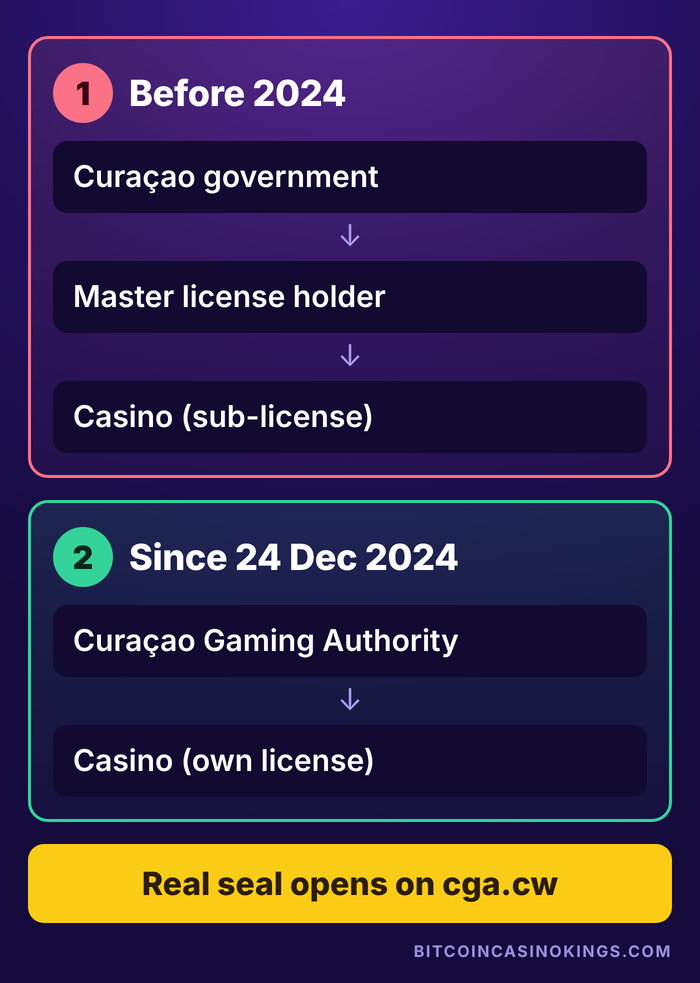
The top half is the old setup. Four master license holders sold sub-licenses to casinos. So a seal led back to one of those companies, not to the government.
The bottom half is the system since 24 December 2024. The Curaçao Gaming Authority now licenses each casino itself, and a real Curaçao seal opens on a cga.cw address.
The CGA’s own check page impressed me. I opened one directly, not from a casino’s footer. It refused to vouch for the website and told me to click the seal on the casino’s site instead.
That’s exactly the instinct you want from a regulator.
I don’t rank one license as safe and another as worthless. I care whether the seal leads somewhere real, because that’s the part you can check yourself.
Licensed Crypto Casinos Where the Seal Checks Out
These are three casinos where I clicked the footer seal today, and each one opened on the regulator’s own page with a matching company name:


BitStarz
BitStarz

mBit
mBit

Bitcasino
Bitcasino
BitStarz and mBit both have an active Curaçao license on the CGA certificate. Bitcasino.io’s Anjouan validation page lists its license as 100% valid.
🔥 Hot BCK Bonus: BitStarz gives new accounts 100 no deposit free spins with code BCK100FREE.
I’d start at BitStarz, where the certificate matched its footer word for word.
Unlicensed Crypto Casinos I’ve Reviewed
Some casinos I list on BCK don’t hold a license. I’d rather show you which ones than pretend they aren’t here. Listing them isn’t a recommendation to play there.
These are the three, plus what each footer showed when I checked:

Ducky Luck
Ducky Luck

Diamond Reels
Diamond Reels

Wolf Casino
Wolf Casino
Ducky Luck shows a Costa Rica badge that doesn’t link anywhere. There’s no license number next to it either.
Diamond Reels’ footer names no license at all. There’s no seal to click and no number to look up.
Wolf says it holds the necessary licenses but names none. I couldn’t find a license name or number on its homepage or in its footer. Its own homepage guide even tells you to check licensing first.
None of that makes them scams. Ducky Luck has run since 2020, and Diamond Reels since 2015. But if a withdrawal stalls, there’s no regulator to take it to.
If you play at any of them, keep balances small, cash out often, and only deposit what you can afford to lose.
The Red Flags: Why Licenses Matter
These are the risks of playing at unlicensed crypto casinos, in the order I’d worry about them.
Zero Oversight
Nobody tests the games. A licensed casino has to use certified random number generators, and an unlicensed one only has to say it does.
So you’re trusting the casino’s word on every spin.
I opened an Anjouan validation page today, and it lists certified random number generators as a condition of keeping the license.
No license means nobody ever writes that condition down.
Limited Legal Recourse
When a payout stalls at a licensed casino, you can go over support’s head. At an unlicensed one, support is the last stop.
Nobody above them can tell them to pay you.
My own routine is one polite chat, then the same message by email so there’s a dated copy. At a licensed casino, that email starts a paper trail a regulator can read.
At an unlicensed one, it’s just an email.
Withdrawals Refused or Winnings Voided
Vague terms do the damage here. A clause about “irregular play” can void a win after the fact, and nobody defines what irregular means.
It’s the first phrase I search for on any terms page, before I even open the bonus section. Search for “irregular,” and you’ll know in seconds how much room the casino gave itself.
My two red flags at any casino are withdrawal fees and poor support.
Without a license, both get worse, because nothing stops a casino from adding fees or going quiet.
Scam Risk
Some unlicensed casinos simply close, with player balances still inside. It isn’t the norm, but it happens.
And there’s no regulator to chase the money afterward.
That’s why I never let a big balance sit in any casino, licensed or not.
Bluff, my rescue dog, doesn’t get to leave food in his bowl overnight. So my winnings don’t get to sit with the cashier overnight either.
Why Some Players Still Choose Unlicensed Casinos
There are real reasons worth flagging here. The draw for these types of players usually comes down to three things:
- Privacy: less paperwork at sign-up, and often no ID check at all
- New ideas: games and features can ship fast without a regulator signing off
- Community trust: a reputation built in public, on forums and in group chats
That last one I get. Back in 2006, a poker room’s reputation lived on the forums. You’ve probably checked a forum before a deposit, too.
And yes, those perks are real. But none of them pays you if a withdrawal stops.
Are No-KYC Casinos Always Unlicensed?
No. Many licensed crypto casinos skip ID checks on small withdrawals.
The license and the KYC rules are two separate questions. I’ve lined up no KYC crypto casinos that still hold a license, with the point at which each one asks for ID.
How to Check a Crypto Casino’s License
You can check a crypto casino’s license in about a minute. All you need is the footer and the regulator’s own site.
Scroll to the footer. Find the license seal or the line naming the regulator.
Click the seal on the casino’s own site. It should open on the regulator’s domain, such as cga.cw for Curaçao.
Note the license number and company name. The seal page shows both.
Check the status and the website. The casino’s address should be listed, and the status should read active or valid.
Match the company name to the terms. The name on the seal should match the one in the casino’s terms.
I ran this check at five casinos today, and most matched cleanly.
One footer still called its regulator the Curaçao Gaming Control Board, the body’s name before the reform. Another printed its license number with a 1 where the validation page showed a capital I.
Neither one worries me on its own. But it’s why you read the seal page, not just the badge.
Signs of a Fake License Seal
These give a fake seal away:
- A static image that links nowhere
- A link that opens on the casino’s own domain
- A license number the regulator’s page can’t find
- A company name that doesn’t match the terms
- One license named in the page copy and a different one in the footer
That last one turned up today, at a casino whose page copy named a Curaçao license while its footer named a different regulator entirely. It may just be old copy.
Still, I’d want the casino to tell me which one is real.
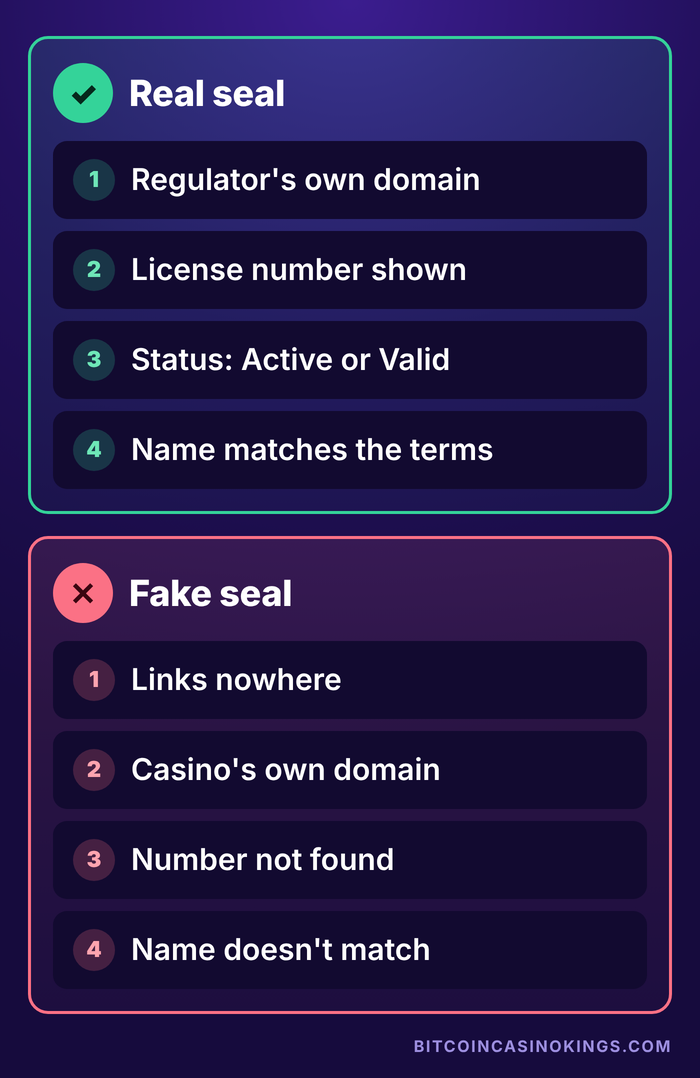
The green card is what a real seal shows when you click it. The red card lists the ways a fake one gives itself away.
One line from the red card is reason enough to dig deeper before you deposit.
A real license has nothing to hide. It lets you click straight through to the proof.
Rogue Crypto Casino Warning Signs
A missing license is the loudest warning, but there are quieter ones.
Nobody owns it on paper
The site shows no company name, registered address, or license holder.
The terms keep changing
Rules shift every few weeks, with no date on the changes.
Low withdrawal caps or long “pending” periods
A tiny weekly cap, or a withdrawal that sits pending for days. I always send a small first withdrawal before I play big, and you should too.
No responsible gambling tools
You won’t find deposit limits, a cool-off option, or self-exclusion.
A copied or broken seal
The checks above catch this one in under a minute.
The same complaint, over and over
One angry forum post means little. Twenty about the same unpaid withdrawals mean a lot.
One sign is a reason to read closer. Three is a reason to leave.
Provably Fair Isn’t a License
Provably fair lets you check that a bet’s result wasn’t changed after you placed it. It says nothing about whether the casino will pay you.
What Provably Fair Proves
| Provably fair proves | It doesn’t prove |
|---|---|
| The result wasn’t changed after your bet | The casino will pay you |
| Each result came from the seeds shown | The casino holds enough funds |
| You can audit the seeds yourself | Disputes get handled fairly |
I check seeds for fun on slow evenings. But I’d never treat a verified roll as proof the cashier works.
If you want to try it, start with provably fair games where you can audit each result yourself.
Is It Illegal to Play at an Unlicensed Crypto Casino?
It depends on where you live. Some countries only regulate the casino. Others block sites they haven’t licensed, and a few penalize players directly.
⚠️ Reminder: I’m not a lawyer, and nothing here is legal advice.
The law usually targets the casino, not you. But “usually” isn’t a promise.
The answer changes at every border, even between Tallinn and Helsinki. So I won’t guess for your country.
Here’s how the law treats Bitcoin gambling in your country. Check it before you sign up anywhere.
What to Do if an Unlicensed Casino Won’t Pay Out
Start the paper trail early. Your records are your only leverage.
Keep records. Save transaction hashes, chat logs, and screenshots.
Ask support in writing. Start in live chat, then follow up by email so there’s a dated copy.
Complain to the licensing body. If the casino claims a license, contact the regulator behind it.
Go public. Post the details on complaint sites and the Bitcointalk scam accusations board.
I’ll be straight with you. Without a regulator, getting the money back is unlikely.
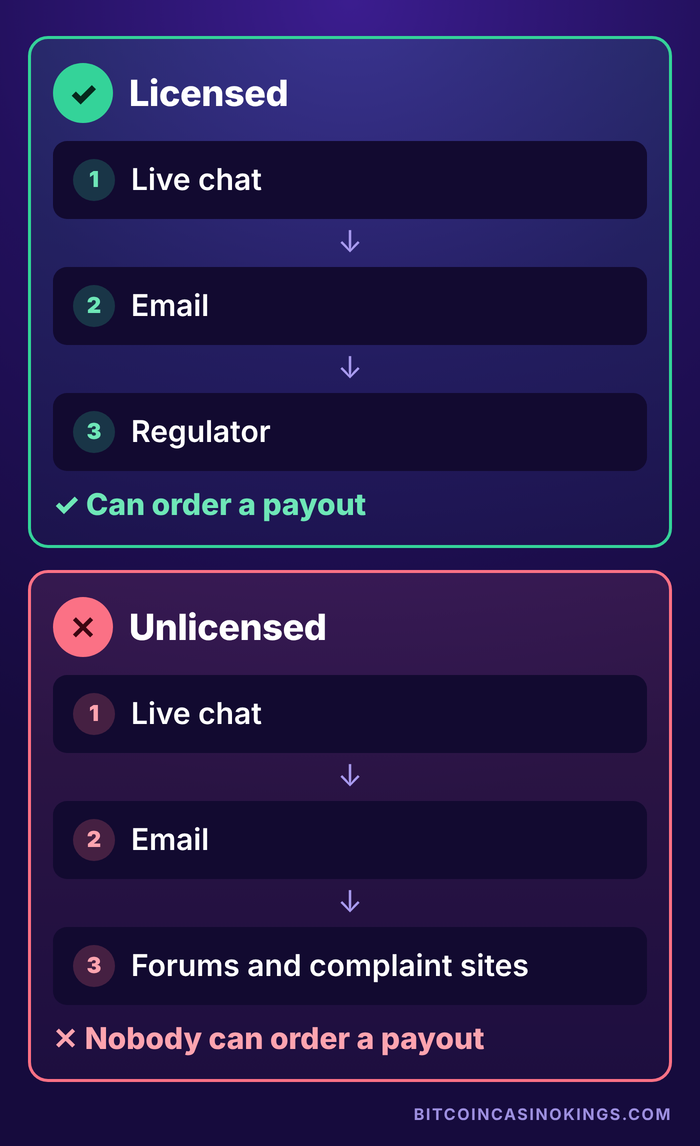
Both paths start the same way, with live chat and then an email for a dated copy. The third step is where they split.
At a licensed casino, the regulator can order a payout. At an unlicensed one, a public post is all you’ve got left.
So I screenshot the withdrawal screen before I confirm anything. Do the same, so you have a record before anything goes wrong.
Verdict: To License or Not to License?
Play at licensed crypto casinos, and check the seal yourself. Treat anything at an unlicensed one as money you can afford to lose.
A license won’t make a casino perfect. But it gives you a regulator to knock on.
💡 BCK Pro Tip: The seal check takes under a minute. Do it before your first deposit, not after your first problem.
Whichever casino you pick, set your limits first. These are the responsible gambling tools worth setting up at any casino.
Footers are boring, I know. But you and I both know the boring parts are where your money’s protected.
More Crypto Casino Guides on BCK
Got a few more minutes? These pick up where this page leaves off.
Fast Withdrawal Casinos for a Quick First Cash-Out
A small first withdrawal tells you how a casino pays. These casinos pay out the fastest.
My Game Got Stuck Mid-Bet. What Now?
A frozen game isn’t a refused payout, but it can feel scary in the moment. Here’s what to do, and why your win is usually safe.

The Bitcoin Casino Basics Before Your First Deposit
New to crypto casinos? Start with wallets, deposits, and bonuses before you worry about seals.